Custom Search
|
|
Attractions of Orkney
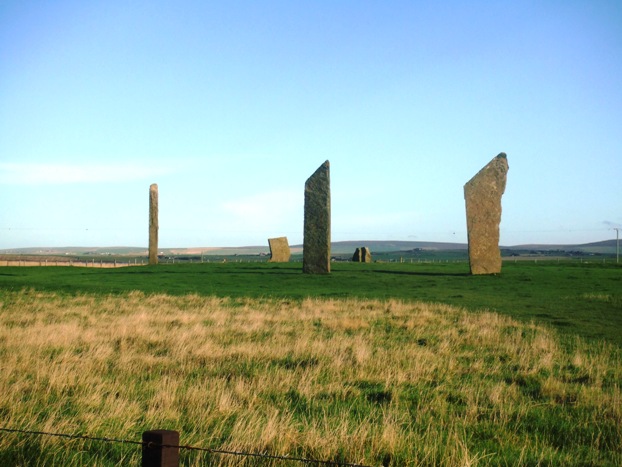
Standing Stones of Stenness
Short and long day tours of Orkney feature the best-known archaeological sites such as Skara Brae, the Ring of Brogar, Standing Stones of Stenness, Maes Howe and the Italian Chapel. The coach route from Burwick crosses all the Churchill barriers constructed by Italian prisoners during the Second World War to link the southern isles (South Ronaldsay and Burray) to the Mainland of Orkney. The main intention of the concrete causeway was to block entry by German submarines into Scapa Flow, the Royal Navy's northern anchorage.
Along with the southern isles and the Mainland of Orkney there are a dozen or so inhabited islands and scores of rocky islets that are homes to seals, birds and isolated flocks of sheep. Today, most Orcadians live on the Mainland and increasingly cluster around Kirkwall and the other large communities where the full benefits of modern life are readily available.
On the outer isles. particularly to the north, life is more fragile and dependent on ferries and airlinks. Most of these islands - such as Stronsay, Eday, Sanday, Westray, Rousay and Egilsay - have experienced considerable depopulation over the last century. But there are signs of rejuvenation, for example Papa Westray (one of the smallest isles) has maintained its population in recent years as incomers from the South have been attracted by the quality of island life, its natural beauty and the oldest standing settlement in North West Europe at the Knap of Howar.
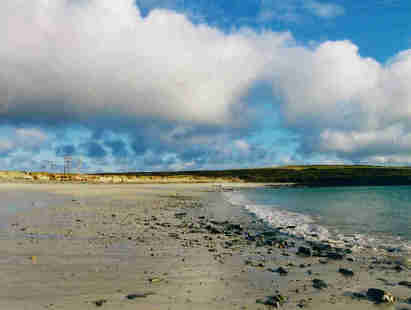
Weather races across the islands
Most visitors to Orkney arrive in the summer months, particularly June to September. Placed as they are between the Atlantic Ocean and the North Sea, no time of year is immune from fog banks, strong winds and rain. Visiting Orkney is always a matter of 'pot luck', although the summer months obviously are more likely to offer good weather. Conversely, there can be some superb days out of season. Unfortunately, travel writers rarely visit at these times and being southerners (just about everywhere is south of Orkney), their prejudices are often clearly visible. Most seem convinced that there is scarcely any daylight in winter and that the islanders batten down hatches outside the tourist season to withstand nine months of bombardment from the weather. Not so.
Orkney Islands
To the north of Scotland, across the racing tides of the Pentland Firth, the fertile Orkney Islands contrast verdantly with the wilds of Caithness and the Scottish HighlandsKirkwall
Kirkwall is the capital of the Orkney islands. Its most significant building is the magnificent St Magnus Cathedral founded in 1137 by Rognvald III and built in the Norman style.Knap of Howar
The oldest known standing settlement in North-West Europe lies on the west shore of Papa Westray in OrkneyReferences
Alexander Fenton (1978) The Northern Isles: Orkney and Shetland, re-published by Tuckwell Press in 1997. Ian Mitchell (2004) Isles of the North, Birlinn.
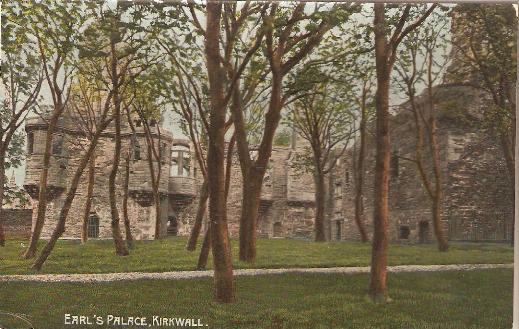
Earl's Palace, Kirkwall - old postcard
Copyright © 2009-2023 Alan Price and IslandGuide.co.uk contributors. All rights reserved. Island Guide makes minimal use of cookies, including some placed to facilitate features such as Google Search. By continuing to use the site you are agreeing to the use of cookies. Learn more here