Custom Search
|
|
Pembroke
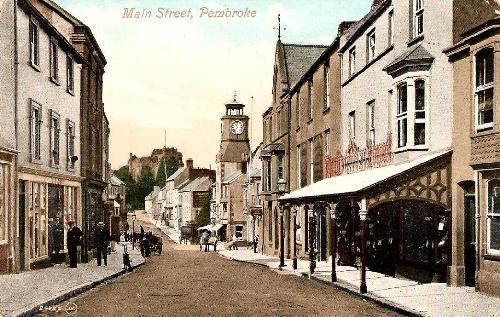
Pembroke Main Street, old postcard
'...I had passed Pennan Pill and drove slowly down the main street of Pembroke to the gates of the castle.
'When I saw the towers of the castle, their serene grace and dignity mirrored in the waters of a haven inlet, I had come to the (...) end of my own journey in the Land beyond Wales. I walked slowly in the streets of this small market-town that is almost completely overshadowed by its history. I was unwilling to detach myself from the old world to the new, and found a place to luch where it seemed I might rest and eat unhurried.'
'(...) I was safe in Pembroke Castle, as many men have been safe before me. Of all the Welsh castles I had seen this was the mightiest, the richest too in history. Arnulph de Montgomery, perhaps attracted by the great cavern under under the limestone ridge, began the building in the reign of Rufus; Strongbow led his men from its gates in the days of Stephen; in 1456 Henry VII was born within its walls when Jasper Tudor was its lord. All through those stormy years it remained impregnable, until Cromwell brought guns along from Bristol and took it in 1648. Pembroke is without doubt the castle to see, if you would see a castle, and only my memory of Kidwelly mirrored in the river flood of the Gwendraeth Fach on a spring evening is more beautiful than Pembroke from the small bridge over the inlet.
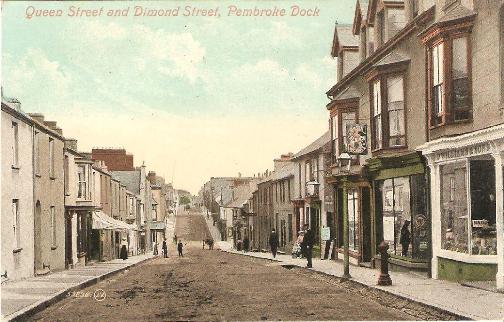
'I went on from Pembroke into old Pater, now called Pembroke Dock. (...) It is a simple little place, its rows of singly story cottages, their rough, cemented roofs stepping down the sloping streets, attractive in their prim severity.' (Thompson, 1937:84-86)
Pembroke Dock, Queen and Dimond Streets, old postcard
Reference
Thompson, R.W. (1937) An Englishman Looks At Wales, Arrowsmith.
Copyright © 2009-2023 Alan Price and IslandGuide.co.uk contributors. All rights reserved. Island Guide makes minimal use of cookies, including some placed to facilitate features such as Google Search. By continuing to use the site you are agreeing to the use of cookies. Learn more here