Custom Search
|
|
The Saxon Invasion - page 2
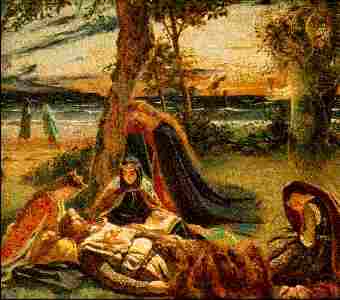
La Morte d'Arthur by James ArcherSummary of the 'traditional story' of conquest
Supposedly, around 456 a phoney peace conference led to a massacre of 300 leading Britons by the Saxons. In the following year, Vortigern died. Vitalinus (Guitolinus) became leader of the pro-Celtic Pelagian faction. At the battle of Aylesford (Kent) Ambrosius, along with the sons of Vortigern, Vortimer and Cateyrn, defeated Hengest for the first time. However, by 458 Hengest finally conquered Kent.
This caused a migration, c.458-60, of British aristocrats and city-dwellers to Armorica in northwestern Gaul (the "second migration"). It became known as Brittany thereafter. The British were led by one Riothamus possibly a title rather than a name.
In the following decade, c.460-70 Ambrosius Aurelianus took control of the pro-Roman faction and the British resistance against the Saxons. Around 466 the Saxons defeated the Britons at the battle of Wippedesfleot, with great slaughter on both sides. Mutual "disgust and sorrow" led to a break in fighting "for a long time." For the next ten years, ancient hillforts were strengthened and the Wansdyke was probably constructed.
Intriguingly, c.469 the Roman emperor, Anthemius, appealed to the Britons for military assistance against the Visigoths.
c.470 at the battle of Wallop (Hampshire), Ambrosius Aurelianus defeated Vitalinus, the leader of an opposing faction to assume supreme power in Britain. In 473, however, Kentish forces, under Hengest, moved westward, driving the Britons before them "as one flees fire.
In 477 the Saxon chieftain Aelle landed on Sussex coast with his sons. The Britons attacked him but his superior force drove them into the forest (Weald). Over the following decade the Saxons expanded their coastal occupation in Sussex. In 486 Aelle and his sons met the Britons in battle at Mercredesburne. The battle was bloody but indecisive, and ended with a truce.
Hengest died around 493, leaving his territory to be ruled by his son Aesc for the next 34 years.
c.495, the Anglo-Saxon Chronicle states that Cerdic and his son Cynric, landed on the south coast, probably near the ampshire-Dorset border. They later formed the kingdom of the West Saxons: Wessex.
Towards the end of the 5th century, the Britons, under the command of Ambrosius Aurelianus defeated the Saxons at Mount Badon. This victory halted the Saxon advance for over 50 years and led to a generation of peace. However, according to Gildas, corrupt leadership, civic disagreements and apathy eroded Romano-British culture.
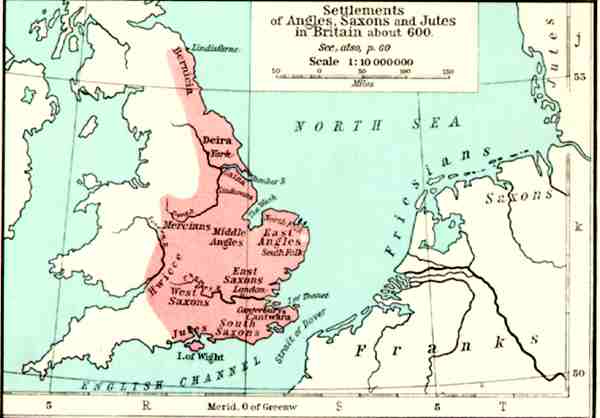
The map shown here comes from Shepherd, William R. Historical Atlas, (1929) and conveys the 'traditional' impression that all native Britons were wiped out in areas under Saxon control.
What happened to London? See Saxon London in a tale of two cities by John Schofield in British Archaeology.
Again from British Archaeology see On the earlier origins of English towns by David Palliser.
What was life like in Anglo-Saxon states? Chris Loveluck writes about Lindsey: Uncovering an Anglo-Saxon 'royal' manor in British Archaeology
By Dr Miles Russell
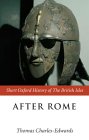
The chapters in this volume, each written by a leading scholar of the period, analyse in turn the different nationalities and kingdoms that existed in the British Isles from the end of the Roman empire to the coming of the Vikings, the process of conversion to Christianity, the development of art and of a written culture, and the interaction between this written culture and the societies of the day. Available from:Amazon.co.uk - British pounds
Amazon.com - US dollars
Amazon.ca - Canadian dollars
Amazon.de - Euros
Amazon.fr - Euros
Copyright © 2009-2025 Alan Price and IslandGuide.co.uk contributors. All rights reserved. Island Guide makes minimal use of cookies, including some placed to facilitate features such as Google Search. By continuing to use the site you are agreeing to the use of cookies. Learn more here