
Custom Search
|
|
History Of The Britons (Historia Brittonum) by Nennius
Previous page of Historia Brittonum
Next page of Historia Brittonum
44. Four times did Vortimer valorously encounter the enemy;[1] the first has been mentioned, the second was upon the river Darent, the third at the Ford, in their language called Epsford, though in ours Set thirgabail,[2] there Horsa fell, and Catigern, the son of Vortigern; the fourth battle he fought was near the stone[3] on the shore of the Gallic sea, where the Saxons being defeated, fled to their ships.
[1] Some MSS. here add, "This Vortimer, the son of Vortigern, in a synod held at Guartherniaun, after the wicked king, on account of the incest committed with his daughter, fled from the face of Germanus and the British clergy, would not consent to his father's wickedness; but returning to St. Germanus, and falling down at his feet, he sued for pardon; and in atonement for the calumny brought upon Germanus by his father and sister, gave him the land, in which the forementioned bishop had endured such abuse, to be his for ever. Whence, in memory of St. Germanus, it received the name Guarenniaun (Guartherniaun, Gurthrenion, Gwarth Ennian) which signifies, a calumny justly retorted, since, when he thought to reproach the bishop, he covered himself with reproach."
[2] According to Langhorne, Epsford was afterwards called, in the British tongue, Saessenaeg habail, or 'the slaughter of the Saxons.'
[3] V.R. "The stone of Titulus, thought to be Stone in Kent, or Larger-stone in Suffolk.After a short interval Vortimer died; before his decease, anxious for the future prosperity of his country, he charged his friends to inter his body at the entrance of the Saxon port, viz. upon the rock where the Saxons first landed; "for though," said he, "they may inhabit other parts of Britain, yet if you follow my commands, they will never remain in this island." They imprudently disobeyed this last injunction, and neglected to bury him where he had ap- pointed.*
* Rapin says he was buried at Lincoln; Geoffrey, at London.45. After this the barbarians became firmly incorporated, and were assisted by foreign pagans; for Vortigern was their friend, on account of the daughter* of Hengist, whom he so much loved, that no one durst fight against him-in the meantime they soothed the imprudent king, and whilst practising every appearance of fondness, were plotting with his enemies. And let him that reads understand, that the Saxons were victorious, and ruled Britain, not from their superior prowess, but on account of the great sins of the Britons: God so permitting it.
For what wise man will resist the wholesome counsel of God? The Almighty is the King of kings, and the Lord of lords, ruling and judging every one, according to his own pleasure.
After the death of Vortimer, Hengist being strengthened by new accessions, collected his ships, and calling his leaders together, consulted by what stratagem they might overcome Vortigern and his army; with insidious intention they sent messengers to the king, with offers of peace and perpetual friendship; unsuspicious of treachery, the monarch, after advising with his elders, accepted the proposals.
* V.R. Of his wife, and no one was able manfully to drive them off because they had occupied Britain not from their own valour, but by God's permission.46. Hengist, under pretence of ratifying the treaty, prepared an entertainment, to which he invited the king, the nobles, and military officers, in number about three hundred; speciously concealing his wicked intention, he ordered three hundred Saxons to conceal each a knife under his feet, and to mix with the Britons; "and when," said he, "they are sufficiently inebriated, &c. cry out, 'Nimed eure Saxes,' then let each draw his knife, and kill his man; but spare the king, on account of his marriage with my daughter, for it is better that he should be ransomed than killed."*
* The VV. RR. Of this section are too numerous to be inserted.The king with his company, appeared at the feast; and mixing with the Saxons, who, whilst they spoke peace with their tongues, cherished treachery in their hearts, each man was placed next to his enemy.
After they had eaten and drunk, and were much intoxicated, Hengist suddenly vociferated, "Nimed eure Saxes!" and instantly his adherents drew their knives, and rushing upon the Britons, each slew him that sat next to him, and there was slain three hundred of the nobles of Vortigern. The king being a captive, purchased his redemption, by delivering up the three provinces of East, South, and Middle Sex, besides other districts at the option of his betrayers.
47. St. Germanus admonished Vortigern to turn to the true God, and abstain from all unlawful intercourse with his daughter; but the unhappy wretch fled for refuge to the province Guorthegirnaim,* so called from his own name, where he concealed himself with his wives: but St. Germanus followed him with all the British clergy, and upon a rock prayed for his sins during forty days and forty nights.
* A district of Radnorshire, forming the present hundred of Rhaiadr.The Blessed man was unanimously chosen commander against the Saxons. And then, not by the clang of trumpets, but by praying, singing hallelujah, and by the cries of the army to God, the enemies were routed, and driven even to the sea.*
*V.R. This paragraph is omitted in the MSS.Again Vortigern ignominiously flew from St. Germanus to the kingdom of the Dimetae, where, on the river Towy,* he built a castle, which he named Cair Guothergirn. The saint, as usual, followed him there, and with his clergy fasted and prayed to the Lord three days, and as many nights. On the third night, at the third hour, fire fell suddenly from heaven, and totally burned the castle. Vortigern, the daughter of Hengist, his other wives, and all the inhabitants, both men and women, miserably perished: such was the end of this unhappy king, as we find written in the life of St. Germanus.
*The Tobias of Ptolemy
By Dr Miles Russell
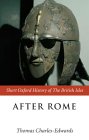
The chapters in this volume, each written by a leading scholar of the period, analyse in turn the different nationalities and kingdoms that existed in the British Isles from the end of the Roman empire to the coming of the Vikings, the process of conversion to Christianity, the development of art and of a written culture, and the interaction between this written culture and the societies of the day. Available from:Amazon.co.uk - British pounds
Amazon.com - US dollars
Amazon.ca - Canadian dollars
Amazon.de - Euros
Amazon.fr - Euros
Copyright © 2009-2023 Alan Price and IslandGuide.co.uk contributors. All rights reserved. Island Guide makes minimal use of cookies, including some placed to facilitate features such as Google Search. By continuing to use the site you are agreeing to the use of cookies. Learn more here