Custom Search
|
|
Tredegar, Monmouthshire
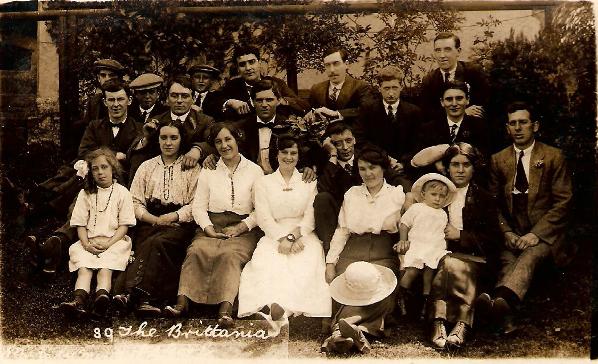
Brittania Inn, Tredegar - card posted 1916From an 1860s description:
'TREDEGAR, a town, chapelry, sub-district in Bedwellty parish and Monmouth district. The town stands on the river Sirhowy, near the Sirhowy District and Merthyr and Abergavenny railways, twelve and a half miles, west south west of Abergavenny. The place was no more than an undistinguished village as recently as 1800, but increased to great importance through the establishment of the iron works by the Homfray family. A tramway was configured on its southern aspect, to carry ore and to export iron and coal. The views here are not pleasing. There is a square in the centre with roads branching from it. It has a main post office and two railway branches. There is a bank, church, eight nonconformist chapels; weekly market on Saturday, and three annual fairs. Population in 1851, 8305; in 1861, 9383. Houses, 1720. The chapelry was established in 1840. Population in 1860, 20,318. Houses, 3643. The living is a perpetual curacy in the bishopric of Llandaff; worth 300p'
The 1920 Kelly's Directory provided this outline:
"TREDEGAR is a town and civil parish formed in 1894 from Bedwellty, with stations at Tredegar and Sirhowy, both close to the town, on the Sirhowy branch of the London and North Western railway, 181 miles from London, 12.5 west from Abergavenny, 7 north-east from Merthyr Tydfil, 16.5 north-west from Pontypool, 22 north-west from Newport and 36 west from Monmouth: it is the head of a county court district, in the Ebbw Vale division of the county, Bedwellty petty sessional division and union, hundred of Wentloog, rural deanery of Bedwellty, archdeaconry of Monmouth, and diocese of Llandaff; that part of the town on the west side of the Sirhowy river is on the property of Lord Tredegar, but George Town is built on land owned by the Tredegar Iron Company: in 1836 the town was formed into an ecclesiastical parish from the civil parish of Bedwellty: the "Local Government Act, 1858," was adopted by the town .June 19, 1874, the district comprising Tredegar and Dukestown parishes, and was extended by 41 and 42 Vict. c. clxiv. and the town was governed by a Local Board until the " Local Government Act, 1894" established the present Urban District Council.
"Tredegar is comparatively a modern town and arose entirely through the establishment of large iron works by the Tredegar Company at the commencement of the 19th century. The town is lighted with gas and is well supplied with water by gravitation from a large reservoir holding 15,.500,000 gallons on the side of the hill above the Poor Law Institution, and a spring situated above Nant-y-bwch capable of supplying a minimum quality of 800.000 gallons per day there is also a reservoir, with a capacity of 50,000,000 gallons, for river compensating purposes; both gas and water works, purchased by the late Local Board at a cost of £53,000, are now the property of the Urban Council, The principal streets diverge from an open space in the middle of the town, called "The Circle," in the centre of which stands a lofty cast-iron column, supporting an illuminated clock. The houses are mostly small and occupied by those engaged in the iron works and collieries of the district."
By 1951 Tredegar could be described in the following way (Olive Phillips, Monmouthshire pp 82-83):
'The mountains towards Tredegar are less stark then the corresponding mountainsides of the Rhymney Valley. There is an incongruous mixture of farms and trees on the hilltops and coal-tips low in the river valley. In the autumn the golden bracken glows against the green of the mountains, and trees break the line of the endless mountain ranges. The land looks less barren than the grey-green of the Rhymney Valley, and cattle as well as the sheep crop the grass. (...)
'Life in a town such as Tredegar must have been very hard, when women as well as men were employed in the mines, and the conditions of work such as they were, with explosions and disease adding to the misery. Several epidemics of cholera broke out in the eighteen-thirties and forties and even later, and later in the century several explosions occurred in Bedwellty Pit and also Pochin Colliery among others. The fortune of all the Valleys seemed to be a thing of fluctuations right from the beginning, with periods of prosperity and poverty alternating. (...)
'As the manufacture of steel became increasingly efficient, and when foreign coal competed on the market with Welsh coal, Tredegar faced great difficulties, and by the eighteen-seventies or eighties the old ironworks were almost at a standstill. (...)
'Like so many of the early iron towns Tredegar, basically, retains many of its old buildings in the main streets, though the facades have a modern look. There is one old shop with a flagstone floor and a low ceiling, which does not look as though it has altered for very many years. Otherwise, apart from this old foundation, Tredegar is a busy place, dominated by its amazing town clock in the Circle.'(...)
Copyright © 2009-2023 Alan Price and IslandGuide.co.uk contributors. All rights reserved. Island Guide makes minimal use of cookies, including some placed to facilitate features such as Google Search. By continuing to use the site you are agreeing to the use of cookies. Learn more here