Custom Search
|
|
Careby, Lincolnshire
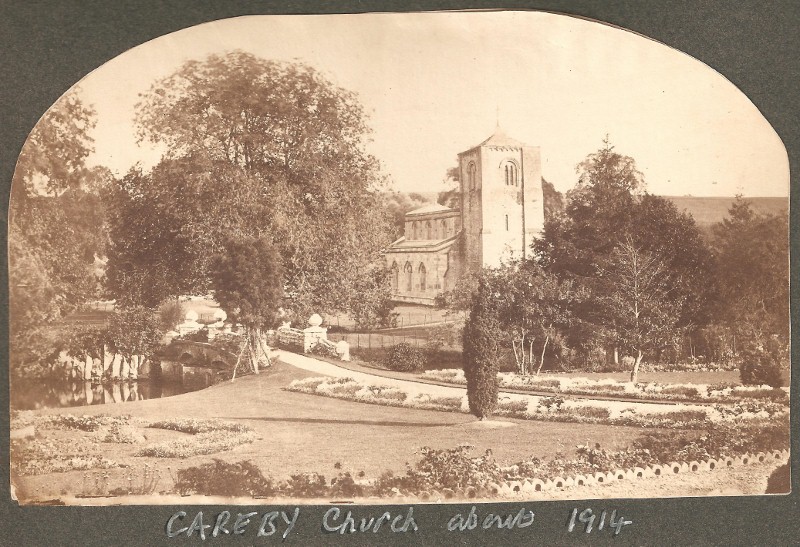
Careby Church pre- World War 1
'Careby (St. Stephen), a parish, in the union of Bourne, wapentake of Beltisloe, parts of Kesteven, county of Lincoln, 6 miles (N. E.) from Stamford; containing 73 inhabitants. It was for many generations the property and residence of the family of Hatcher, of whom Sir John Hatcher, the last who bore that title, died in 1640. The parish comprises by measurement 1418 statute acres: there is a quarry of excellent building-stone. The village is small, but delightfully situated, and of pleasingly rural appearance; and there are still some remains of the ancient mansion of the Hatchers, which was a spacious building with extensive pleasuregrounds, fish-ponds, and a park well stocked with deer. The living is a rectory, valued in the king's books at £8. 17. 1., and in the gift of General Birch Reynardson: the tithes have been commuted for £275, and the glebe comprises 46 acres. The altar of the church is embellished with a large painting of the Salvator Mundi, by the Rev. J. R. Deverell, late rector, who also presented a fine toned organ; in the chancel is a monument to Sir John Hatcher, whose statue is beautifully executed in stone. An excellent parsonage-house has been built.' (A Topographical Dictionary of England, Volume 1, Samuel Lewis (editor), 1848 edition).
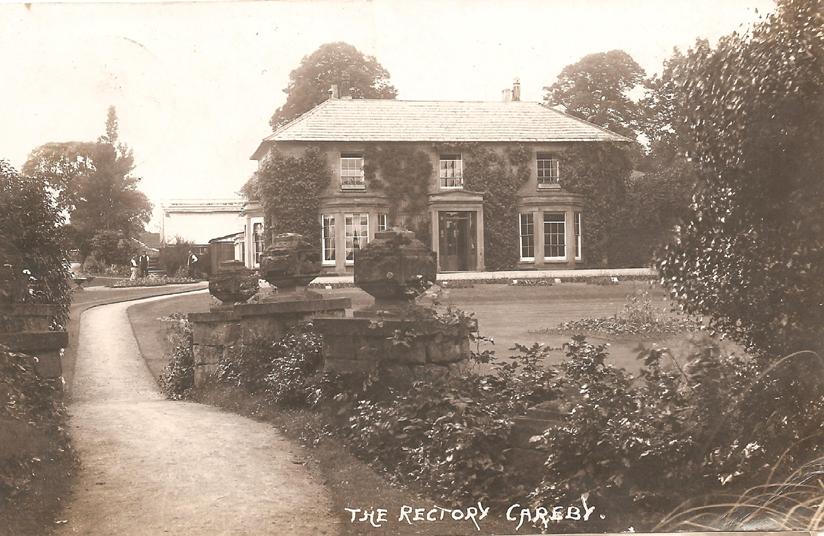
Postcard view of the Rectory and workers, circa World War 1
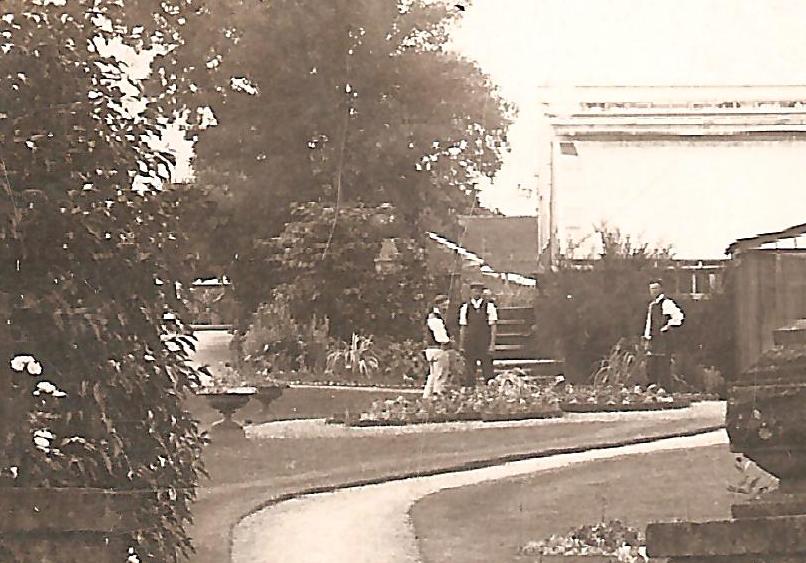
Close-up of workers in Rectory garden
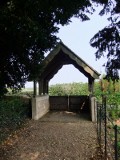
Careby Church
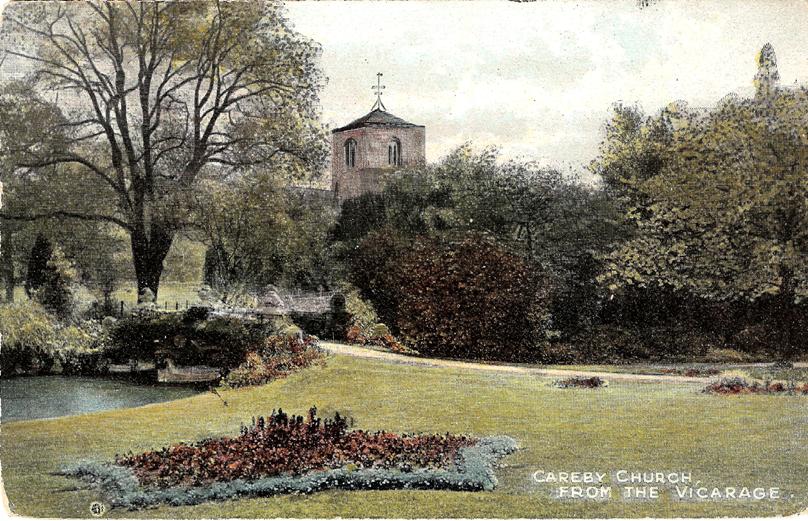
'The approach to the church of St. Stephen through the beautiful grounds of the vicarage is a pleasant preface to its inspection. Originally it was clearly a Norman structure, of which a single window remains in the north wall of the chancel and the doorway opposite to it. The tower comes next in date, and is of the Early English period, crowned by a low conical roof, probably after the form of the original one. The nave is of the Perpendicular period, and had lost its north aisle, which was rebuilt by the present Incumbent in the year 1885. The arcades are of three bays, and are of a late Perpendicular character. The pillars rise from stilted bases, and consist of plain square central members, having circular ones east and west of these. A piscina near the east end of the south aisle shows that there was a chantry chapel there, probably founded by one of the Hatcher family, formerly lords of the manor of Careby, of which two monuments still remain in this church. The oldest is in the chancel, and consists of a stone effigy of a knight of the time of Edward II, having figures of two angels supporting the head, and, as usual, a lion at his feet. The other is in the nave, and a most curious one, of the time of Edward III. It consists of effigies of a knight and his wife, recumbent side by side, beneath a coverlet, he bearing a shield charged with two bars, on a chief 3 escallops. The door of this church is interesting from the conjunction of its planking, its large iron perforated boss, and its ring handle, on which two lizards are wrought.' (From Reports and papers of the architectural and archaeological societies of the counties of Lincoln and Northampton..., 1889).
Careby Church Careby Church from the Rectory Garden, Edwardian postcard
Links to more Careby information
Careby, Lincolnshire - January 1918
Genuki - useful genealogical links for Careby
Detail of Medieval Cope, showing Assumption of the Virgin, c.1500
Copyright © 2009-2023 Alan Price and IslandGuide.co.uk contributors. All rights reserved. Island Guide makes minimal use of cookies, including some placed to facilitate features such as Google Search. By continuing to use the site you are agreeing to the use of cookies. Learn more here