
Custom Search
|
|
History Of The Britons (Historia Brittonum) by Nennius
Previous page of Historia Brittonum
Next page of Historia Brittonum
29. We must now return to the tyrant Maximus. Gratian, with his brother Valentinian, reigned seven years. Ambrose, bishop of Milan, was then eminent for his skill in the dogmata of the Catholics. Valentinianus and Theodosius reigned eight years. At that time a synod was held at Constantinople, attended by three hundred and fifty of the fathers, and in which all heresies were condemned. Jerome, the presbyter of Bethlehem, was then universally celebrated. Whilst Gratian exercised supreme dominion over the world, Maximus, in a sedition of the soldiers, was saluted emperor in Britain, and soon after crossed the sea to Gaul. At Paris, by the treachery of Mellobaudes, his master of the horse, Gratian was defeated and fleeing to Lyons, was taken and put to death; Maximus afterwards associated his son victor in the government.
Martin, distinguished for his great virtues, was at this period bishop of Tours. After a considerable space of time, Maximus was divested of royal power by the consuls Valentinianus and Theodosius, and sentenced to be beheaded at the third mile-stone from Aquileia: in the same year also his son Victor was killed in Gaul by Arbogastes, five thousand six hundred and ninety years from the creation of the world.
30. Thrice were the Roman deputies put to death by the Britons, and yet these, when harassed by the incursions of the barbarous nations, viz. Of the Scots and Picts, earnestly solicited the aid of the Romans. To give effect to their entreaties, ambassadors were sent, who made their entrance with impressions of deep sorrow, having their heads covered with dust, and carrying rich presents, to expiate the murder of the deputies. They were favourably received by the consuls, and swore submission to the Roman yoke, with whatever severity it might be imposed.
The Romans, therefore, came with a powerful army to the assistance of the Britons; and having appointed over them a ruler, and settled the government, returned to Rome: and this took place alternately during the space of three hundred and forty-eight years. The Britons, however, from the oppression of the empire, again massacred The Roman deputies, and again petitioned for succour. Once more the Romans undertook the government of the Britons, and assisted them in repelling their neighbours; and, after having exhausted the country of its gold, silver, brass, honey, and costly vestments, and having besides received rich gifts, they returned in great triumph to Rome.
31. After the above-said war between the Britons and Romans, the assassination of their rulers, and the victory of Maximus, who slew Gratian, and the termination of the Roman power in Britain, they were in alarm forty years.
Vortigern then reigned in Britain. In his time, the natives had cause of dread, not only from the inroads of the Scots and Picts, but also from the Romans, and their apprehensions of Ambrosius.*
* These words relate evidently to some cause of dispute between the Romans, Ambrosius, and Vortigern. Vortigern is said to have been sovereign of the Dimetae, and Ambrosius son to the king of the Damnonii. The latter was half a Roman by descent, and naturally supported the Roman interest: the former was entirely a Briton, and as naturally seconded by the original Britons.In the meantime, three vessels, exiled from Germany, arrived in Britain. They were commanded by Horsa and Hengist, brothers, and sons of Wihtgils. Wihtgils was the son of Witta; Witta of Wecta; Wecta of Woden; Woden of Frithowald; Frithowald of Frithuwulf; Frithuwulf of Finn; Finn of Godwulf; Godwulf of Geat, who, as they say, was the son of a god, not[1] of the omnipotent God and our Lord Jesus Christ (who before the beginning of the world, was with the Father and the Holy Spirit, co-eternal and of the same substance, and who, in compassion to human nature, disdained not to assume the form of a servant), but the offspring of one of their idols, and whom, blinded by some demon, they worshipped according to the custom of the heathen. Vortigern received them as friends, and delivered up to them the island which is in their language called Thanet, and, by the Britons, Ruym.[2] Gratianus Aequantius at that time reigned in Rome. The Saxons were received by Vortigern, four hundred and forty-seven years after the passion of Christ, and,[3] according to the tradition of our ancestors, from the period of their first arrival in Britain, to the first year of the reign of king Edmund, five hundred and forty-two years; and to that in which we now write, which is the fifth of his reign, five hundred and forty-seven years.
[1] V.R. not the God of gods, the Amen, the Lord of Hosts, but one of their idols which they worshipped.
[2] Sometimes called Ruoichin, Ruith-in, or "river island," separated from the rest of Kent and the mainland of Britain by the estuary of the Wantsum, which, though now a small brook, was formerly navigable for large vessels, and in Bede's time was three stadia broad, and fordable only at two places.
[3] The rest of this sentence is omitted in some of the MSS.
By Dr Miles Russell
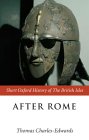
The chapters in this volume, each written by a leading scholar of the period, analyse in turn the different nationalities and kingdoms that existed in the British Isles from the end of the Roman empire to the coming of the Vikings, the process of conversion to Christianity, the development of art and of a written culture, and the interaction between this written culture and the societies of the day. Available from:Amazon.co.uk - British pounds
Amazon.com - US dollars
Amazon.ca - Canadian dollars
Amazon.de - Euros
Amazon.fr - Euros
Copyright © 2009-2023 Alan Price and IslandGuide.co.uk contributors. All rights reserved. Island Guide makes minimal use of cookies, including some placed to facilitate features such as Google Search. By continuing to use the site you are agreeing to the use of cookies. Learn more here